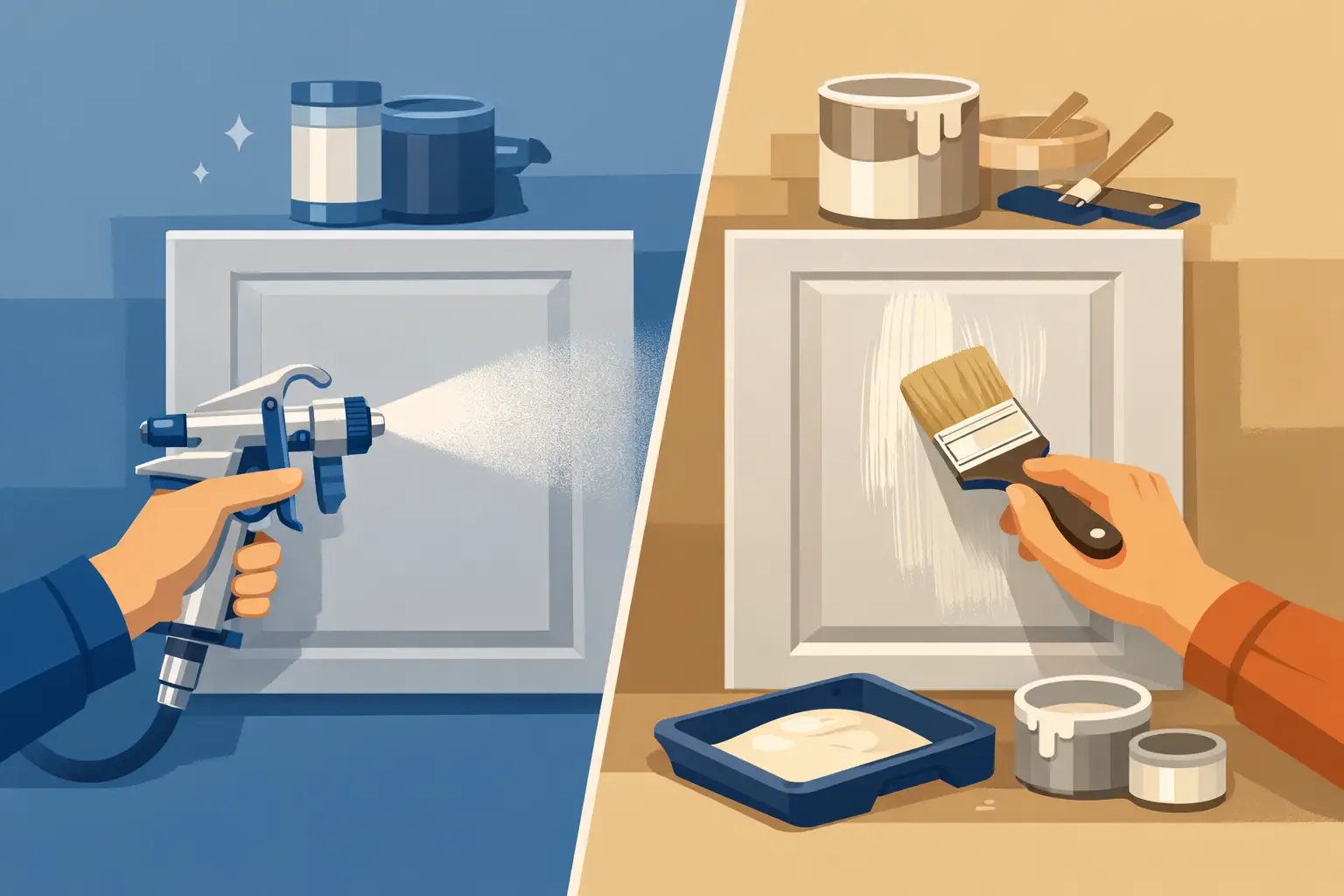
A cabinet repaint can make a dated kitchen feel considered again, but the application method has a direct effect on what you see every day. In the spray vs brush cabinets discussion, spraying is usually the path to a factory-smooth result. That does not mean brushing is automatically poor work. It means the right method depends on the cabinetry, the condition of the room, the coating system, and the standard the finished space needs to meet.
For homeowners who expect cabinetry to read cleanly in morning sun, under pendant lighting, and at close range, this decision should be made before paint is opened. The finish is only as good as the preparation beneath it and the control of the application process.
Spray vs Brush Cabinets: The Visible Difference
Spraying applies a fine, even film of coating across the surface. When the doors, drawer fronts, and cabinet boxes have been properly cleaned, sanded, primed, and sprayed under controlled conditions, the result has minimal texture. Profiles, routed edges, and recessed panels receive consistent coverage without the overlap marks that can develop during hand application.
Brushing leaves a more hand-applied character. A skilled painter using a high-quality cabinet enamel can minimize brush marks, particularly on frames, trim details, or small repairs. Modern waterborne alkyd products also level better than many older coatings. Still, even a carefully brushed door will generally show more texture than a sprayed door when viewed across the surface in direct light.
That difference matters more on broad, flat cabinet fronts. A painted shaker kitchen, for example, has long rails and flat center panels that reveal minor texture quickly. On highly detailed, older cabinetry with narrow profiles and limited uninterrupted surface area, the distinction may be less noticeable. The expectation for the room should guide the process.
Why Spraying Is the Premium Cabinet Standard
For most full cabinet refinishing projects, spraying is the preferred method because it produces a more uniform finish. Doors and drawer fronts can be removed, labeled, and finished horizontally in a controlled work area. This gives the coating time to level properly and allows the painter to coat all edges consistently.
Spraying cabinet boxes in place requires a different level of site preparation. Countertops, appliances, floors, walls, openings, and adjacent rooms must be masked carefully. Hardware is removed where practical, and the work area needs containment and ventilation planning. This is not a shortcut process. A clean spray job depends on meticulous prep, disciplined masking, and a crew that treats the occupied home as part of the scope.
The advantage is visual consistency. Doors, drawer fronts, end panels, face frames, and exposed boxes can be finished to the same sheen and texture standard. That matters in kitchens with open shelving, islands, integrated panels, or large sightlines into adjacent living spaces.
Spraying also gives better control over complex profiles. Cabinet doors with beadboard, raised panels, inside corners, or decorative millwork are difficult to brush without leaving excess material in corners or thin coverage on edges. A controlled spray pass can build an even coat across those transitions.
When Brushing Can Be the Right Choice
Brushing has a place in cabinet work, but it should be used intentionally. It can be practical for localized touch-ups, small repairs, narrow face-frame areas, and details where masking or disassembly would create disproportionate disruption. A brush also allows a painter to work coating into tight joints and small gaps before a final finish coat is applied.
Some occupied homes are not suitable for extensive on-site spraying. A kitchen may be central to daily family life, poorly isolated from other rooms, or located in a condominium with strict work rules. In those cases, doors and drawer fronts may still be sprayed off-site or in a contained area while selected fixed components are hand-finished. The goal is to maintain an appropriate standard without creating unnecessary risk or disruption.
A fully brushed cabinet repaint can also suit a lower-traffic utility room, a rental property, or cabinetry where a lightly textured painted look is acceptable. It is simply not the typical choice for a premium kitchen renovation where a smooth, furniture-grade appearance is expected.
Durability Is Not Decided by the Spray Gun
A sprayed finish is not automatically more durable than a brushed finish. Durability comes from the full coating system: cleaning, deglossing or sanding, repairs, adhesion primer, compatible finish coats, proper film thickness, and curing time. Skip those steps, and even a beautiful sprayed surface can chip, peel, or wear prematurely.
Kitchen cabinets are exposed to hand oils, steam, grease, food splatter, and repeated contact around pulls and drawer edges. The existing surface must be assessed before refinishing begins. Factory coatings, previously painted surfaces, laminate components, wood veneer, and thermofoil all require different preparation decisions. Not every cabinet is a straightforward repaint candidate.
A professional cabinet process typically includes removing doors and hardware, degreasing thoroughly, sanding to create a mechanical bond, addressing dents and failed caulking, spot-priming repairs, and applying a bonding primer suited to the substrate. The selected topcoat must be designed for cabinets and trim, not simply a wall paint applied at a higher sheen.
Cure time deserves equal attention. Cabinet coatings may feel dry within hours but need additional time to develop hardness. Reinstalling doors too early, stacking freshly finished parts, or cleaning aggressively before the coating has cured can compromise an otherwise excellent result. A dependable schedule includes time for the finish to perform, not just time to apply it.
The Job Site Changes the Method
The difference between a clean cabinet project and a stressful one is often operational rather than technical. Spraying inside an occupied home demands a defined work plan. The crew needs clear protection boundaries, dust control during sanding, labeled storage for doors and hardware, daily cleanup, and a reliable sequence for reinstalling components.
For a high-end home, the cabinet repaint should not turn the rest of the house into a work zone. Floors need protection, countertops must remain secure, and adjacent finishes require careful masking. A foreman-led crew can coordinate each stage, inspect the preparation before coating begins, and keep the schedule clear for the homeowner or general contractor.
Brushing reduces overspray risk, but it does not eliminate the need for job-site discipline. Sanding dust, degreasing products, open cabinet interiors, and removed hardware still need to be managed carefully. A brush is an application tool, not a substitute for proper containment and cleanup.
Choosing the Right Cabinet Painting Method
The decision usually becomes clear once the project is evaluated against the expected finish level. Spraying is generally the right choice when the goal is a smooth, consistent finish across a visible kitchen, vanity, built-in, or island. It is particularly well suited to flat doors, modern cabinetry, and rooms with strong natural light that will reveal surface texture.
Brushing may be appropriate for minor work, difficult-to-access fixed details, or projects where the client accepts a more hand-applied appearance. In many quality cabinet projects, the strongest approach is a controlled combination: spray the removable components and major visible surfaces, then hand-finish limited areas where that produces the cleanest result.
The questions worth asking are practical. What material are the cabinets made from? Is the current coating sound? Can doors be removed and finished under controlled conditions? How much of the kitchen needs to remain usable during the work? Most importantly, should the result look freshly painted, or should it read like a newly finished cabinet system?
A cabinet repaint should be judged after the masking is removed, the doors are reinstalled, and the room returns to normal use. Choose the method that supports that final standard, with preparation and curing treated as seriously as the final coat.