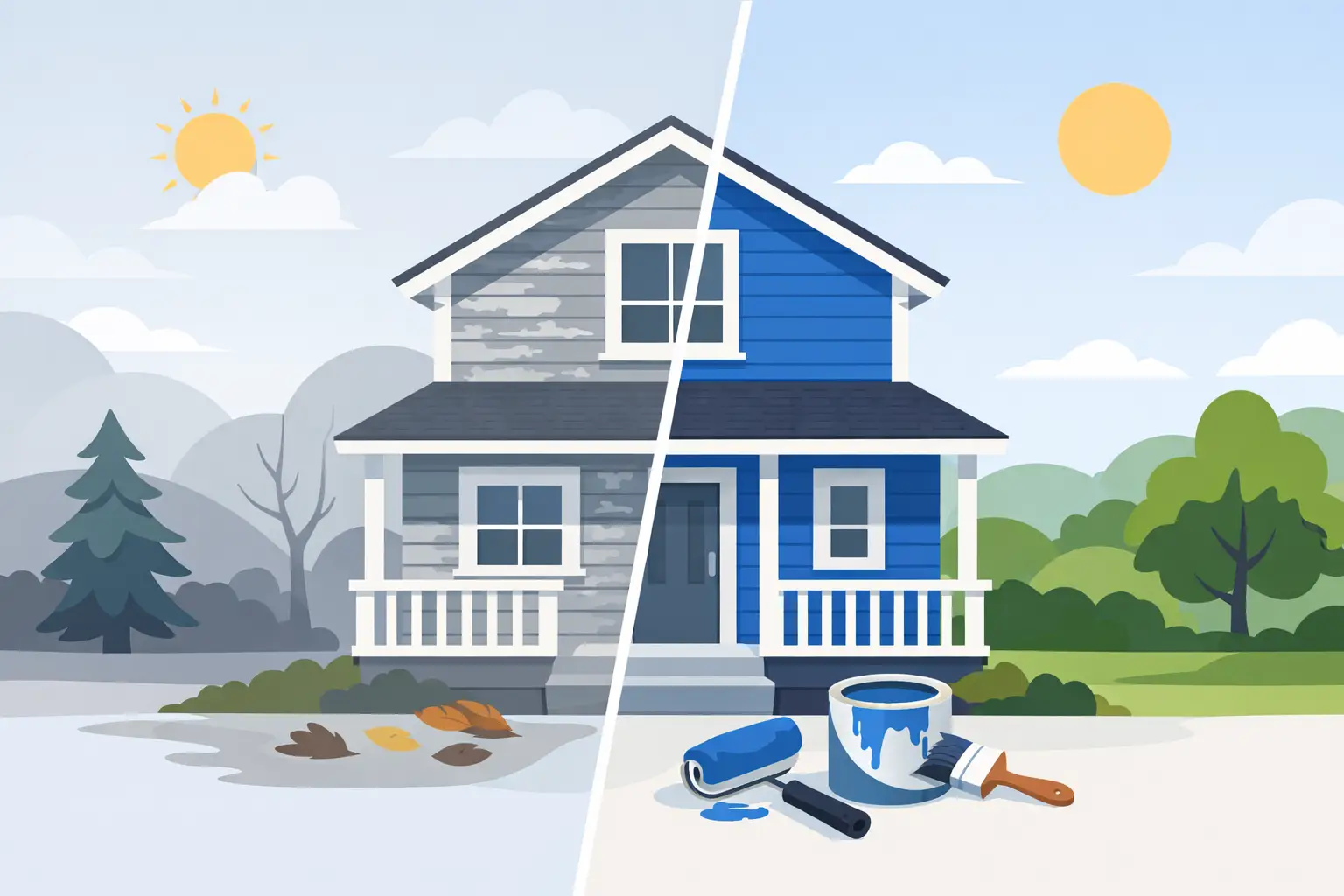
Fresh exterior paint can make a house look sharply maintained, but appearance is only part of the job. When homeowners ask how often should you repaint exterior siding, the better question is usually this: how long will this specific paint system hold on this specific house? The answer depends on siding material, exposure, climate, previous prep, and whether the last paint job was built for durability or simply for a quick visual reset.
For most homes, exterior siding needs repainting every 5 to 12 years. That range is wide for a reason. A shaded brick home with properly coated trim and high-grade masonry paint will age very differently than a south-facing wood-sided home that takes full sun, wind, and freeze-thaw cycles every season. In premium residential work, repaint timing should be based on condition, not guesswork.
How often should you repaint exterior siding by material?
Siding material is the first variable because paint adheres, expands, and weathers differently from one surface to another.
Wood siding usually needs repainting most often. A realistic range is every 5 to 7 years, though some well-protected elevations can stretch longer. Wood moves with moisture and temperature changes, and once coatings begin to crack or lift, water can enter quickly. If the home has older clapboard or cedar siding, repainting on time is less about cosmetics and more about preventing substrate damage.
Engineered wood and hardboard products often perform in a similar range, though factory-primed products may hold paint slightly longer when they were installed and coated correctly. The limiting factor is still exposure and moisture management.
Fiber cement siding commonly holds paint for 8 to 12 years. It is dimensionally more stable than wood, which helps, but longevity still depends on proper caulking, clean substrate conditions, and full coverage at cut ends, joints, and exposed edges. When fiber cement is repainted before major breakdown starts, the finish tends to stay cleaner and more even.
Aluminum siding can often go 5 to 10 years between repaints. Oxidation is the issue here. If the surface was not cleaned and prepared thoroughly before the last coat, paint may fail early even if the siding itself is still sound.
Vinyl siding is a separate case. It does not always need paint at all, and when it is painted, product selection matters. A properly specified coating can last 7 to 10 years or more, but dark color changes can create heat-related movement issues. Not every vinyl repaint is a good candidate for long-term success.
Stucco and masonry surfaces can hold coatings for 10 years or longer, but only when cracks, moisture entry points, and chalking are addressed first. These surfaces often look fine from the street while quietly failing in isolated areas.
Why the repaint timeline varies so much
Two homes on the same street can have completely different repaint cycles. That is not marketing language. It is simply how exterior coatings behave in the field.
Sun exposure is one of the biggest factors. South- and west-facing elevations age faster because UV exposure breaks down binders and fades color. Darker colors absorb more heat, which can accelerate stress on both paint film and substrate. Lighter, more reflective colors often age more gradually.
Moisture exposure is just as important. Areas near rooflines, downspouts, decks, grade lines, and poorly ventilated corners tend to fail first. Paint does not usually peel because it got old. It peels because moisture pressure, weak adhesion, or improper prep gave it a place to let go.
Climate also matters. In regions with freeze-thaw cycles, wet springs, hot summers, and long winters, exterior paint works harder. Expansion and contraction can open hairline cracks, stress caulk joints, and expose edges that looked intact a season earlier.
Then there is workmanship. A surface that was washed properly, scraped to a sound edge, spot-primed where needed, caulked carefully, and top-coated at the correct spread rate will outlast a rushed repaint by years. Homeowners often underestimate how much durability is decided before the finish coats ever go on.
The signs your siding needs repainting sooner
The calendar is useful, but it should not be the only trigger. Exterior paint often gives warning signs before full failure sets in.
Fading is one of the first. If one elevation looks noticeably lighter or flatter than the others, the coating may be losing protective integrity along with color depth. Fading alone is not always an emergency, but it often signals that the finish is nearing the end of its service life.
Chalking is another indicator. If you run a hand across the siding and get a powdery residue, the paint film is breaking down on the surface. Left too long, that can interfere with adhesion during repainting and may require more extensive prep.
Cracking and flaking are more serious. Once paint begins to split, moisture can move behind it. On wood siding especially, waiting too long can turn a repaint into repair work.
Caulk failure around joints, trim transitions, and penetrations is also a repaint signal. Even if the field of the siding still looks acceptable, failed sealant can allow water behind the coating system. A disciplined exterior inspection always looks at paint and sealant together.
Mildew, staining, or persistent discoloration may point to moisture retention or drainage issues. Repainting without correcting the source is rarely money well spent.
How often should you repaint exterior siding if the last job was done well?
A well-executed paint job should buy time, but only if the system was built properly from the start. That means substrate-specific prep, premium primers where required, finish coats applied at the right film build, and a schedule that allowed surfaces to dry and cure appropriately.
In that case, repainting can happen closer to the longer end of each material range. Wood might approach 7 years instead of 5. Fiber cement may hold closer to 10 or 12. Masonry may go beyond a decade in lower-stress conditions.
But “done well” has a strict definition. A clean-looking result on day one does not prove long-term performance. Many premature failures trace back to skipped scraping, marginal sanding, unaddressed chalking, or painting over failing caulk. A premium exterior repaint is less about covering and more about resetting the envelope properly.
Repaint before failure, not after
This is where homeowners can save money over time. Repainting siding when the coating is weathered but still largely intact is usually more efficient than waiting for widespread peeling, exposed substrate, and trim joint failure.
Once deterioration becomes obvious from the curb, prep requirements tend to increase. More scraping, more spot priming, more carpentry coordination, and more time are needed to restore a stable surface. The scope becomes less predictable as well, especially on older homes.
For higher-value properties, proactive repainting also protects visual consistency. Sun-faded siding, patched sections, and isolated repairs tend to read unevenly in changing light. A proper repaint completed before severe breakdown preserves a more uniform finish and reduces the chance of rushed spot work later.
A practical schedule for homeowners
Rather than asking whether your house has hit a universal repaint date, inspect it annually and plan more formally every few years. Walk the perimeter in good daylight. Look closely at sun-exposed walls, horizontal trim, lower siding courses, corners, and areas near gutters and doors.
If the paint is 4 to 5 years old on wood, or 7 to 8 years old on fiber cement or aluminum, it is reasonable to schedule a professional assessment even if major defects are not yet obvious. That is usually the right moment to catch issues while prep is still straightforward.
For homeowners who prioritize finish quality and property upkeep, repainting should be treated as part of exterior maintenance, not as a last-response fix. On well-kept homes across mature neighborhoods, that approach consistently delivers better outcomes than stretching another year or two out of a tired coating system.
At Whitmore Painting, that assessment starts with the substrate, the failure points, and the prep burden required to bring the exterior back to a stable standard. That is the only reliable way to answer the timing question honestly.
If your siding still looks acceptable from a distance but is starting to fade, chalk, crack, or open at the joints, that is usually the window to act. The best repaint is not the one you postpone until it is unavoidable. It is the one done while the surface is still sound enough to hold a finish the right way.